History

History of All Saints’ Sanderstead

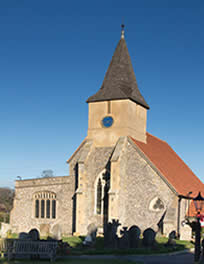
All Saints’ Parish Church stands on the summit of Sanderstead Hill at 596 feet above sea level.

The first recording of  Sanderstead can be found in the will of Duke Alfred in 871. On his death he left 32 hides within Sanderstead and Selsdon. About 964 AD, Ethelfleda, daughter of Earl Ordmar, first wife of King Edgar and mother of Edward, King and Martyr, gave the manor of Sanderstead, with eighteen hides, to the  Abbott and Convent of St Peter’s, Hyde, Winchester. There is a tradition that there was a Saxon church on the site of the present Parish Church and there is a little evidence that some older masonry was used in building the church.

Sanderstead is mentioned in the Domesday book, being in the Wallington Hundred, with land for 10 ploughs, 21 “villagers” i.e. heads of families and 1 cottager, and enough woodland to graze 300 pigs.

The present church was begun in about 1230 AD during the reign of Henry III, with the tower added about 1310AD. The walls are of local knapped flint, and the church was originally roofed with wooden shingles. In 2008 the spire was re-roofed with traditional wooden shingles, a job which will have been repeated regularly over the past 800 years.

The church is built in the Early English style and originally it had a nave, a raised chancel and a small aisle on the north and south sides. In a pillar supporting the north-east corner of the nave is a small piscina, thought to date from 1230, suggesting that there may have been a small chapel on that side.

In 1936 when two boards with the ten commandments on were removed from either side of the east window, two wall paintings were discovered, on either side of the high altar, and these have been dated to the 14th century. They depict St Edmund, King of East Anglia who was martyred by the Danes in 870 - a saint much revered in medieval England - and Edmund, Archbishop of Canterbury in the 13th century at the time the church was built. It has been suggested that the paintings were possibly intended as a link between an earlier Saxon church dedicated to St Edmund and the 13th century church built during Archbishop Edmund’s time.

The entrance to the church is through a porch in the south aisle . The wooden door at the main entrance is almost certainly the 13th century original. At the back of the church are two “Dogwhipper” benches which were used by Shepherds who could keep an eye on their dogs and sheep during the services.

The earliest memorials in All Saints’ church are two brasses, one to John and Dyones Atwood who died in 1525 and 1530 respectively, and the other to Nicholas Atwood who died in 1586.

“Sanderstead Parish Church (All Saints’) stands within the enclosure of the park grounds of two splendid residences, Sanderstead Court (now known as Selsdon Court) and Selsdon Park; thus latter was for many years the palace of the Rev. Dr. Thorold, then bishop of Rochester, both within the same park grounds, have lately been acquired by A.D. Sanderson, Esq, under whose able management they have been converted into first class private residential hotels”

“From Sanderstead Parish Church by Rev. F.W.Walker”.

Historical information is taken from “The Bourne Society, Village Histories no 3 Sanderstead” Edited by Joy Gadsby, with kind permission from the editor.

St. Mary’s - A Short History

In 1801 the Parish of Sanderstead, centred on All Saints church at the top of Sanderstead Hill, had a population of 204 and was described as ‘an idyllic village with herdsmen, some cottages, woods, fields finely cultivated and sheep walks well stocked and with distant views of the Royal Castle of Windsor’.

The coming of the railway to Sanderstead in 1884 and to Purley Oaks in 1889 inevitably altered this quiet rural scene. heralded the building of houses along the muddy lanes cut through the farmland. The population of the Parish, was 2,853 by 1911.

It became obvious that with all the new housing springing up round Purley Oaks and Sanderstead stations further provision would have to be made for those who wished to worship regularly and nearer to their homes. A mission district was planned with the long-term vision of a permanent church to be built later, and a separate Parish created.

Land on which to erect a temporary church building was donated by Mr Arkwright from the Arkwright Estate. The original building is now the church hall and is still used today. It was opened in February 1908 by Dr Talbot, the then Bishop of Southwark. An extension to the building was added in 1915 and at the same time plans were made, and fund-raising started, for the building of a permanent church. The original intention was for the church to be built in a 14th-century style with a seating capacity of 846. The inflationary conditions following the 1914-18 war caused the plans to be reduced to a building seating about 500, with further economies in both the style and materials.

Work was started on July 21st, 1925 but it soon became clear that further savings would have to be made. Instead of the proposed four bays and a porch at the west end of the church, three bays of the nave and aisles were built with a temporary west end and porch of timber framing, standing on a low brick wall. Thus leaving one bay and the porch for completion at a later date. The total cost of the building, in 1926 was £9,112.

During the Second World War the church roof was damaged by a flying bomb. During the Sixties the East Window was replaced by the beautiful stained glass scenes illustrating the life of Jesus, and memorial stained glass windows were put into St John’s Chapel. Towards the end of the Sixties the temporary west end of the church was beginning to show signs of movement and so plans were made to complete the church. The completion of the church was marked by a Service of Dedication led by the Right Reverend David Shepherd, Bishop of Woolwich on February 25 1971.

By 1980, shafts of light could be seen through the ageing timbers of the Church Hall’s walls, it was obvious that something had to be done. It was estimated that the work could cost as much as £50,000, but by March 1982 around £29,000 had been promised, enough to get the hall re-roofed but not enough for all the work to done by professionals. So a dozen or more members of the congregation worked on the interior every Saturday for an entire year reinforcing the walls with polystyrene and plasterboard and laying a new floor. They went on to build the washrooms at the front and lay the paving.

Thanks to a bequest in 1987 of £98,000 from Hilda Oclee who together with her sister Olive had attended the church since its early days. The first project was an extension to the church hall, which hosts activities ranging from wedding receptions and birthday parties to keep-fit classes, and its regular use by Sanderstead Junior School. So in 1995 the Oclee Room was built on to the hall at a cost of £75,000.

We had always been close to the United Reformed Church and in 1996, the friendship was formalised as the two churches joined together in the Local Ecumenical Project, commemorated in the porch of St Mary’s. Now, built into the two churches’ activities, are regular united services and annual events such as the recent Maundy Thursday and Good Friday celebrations, which members of both the URC and St Mary’s attend.

Services reverted to the Church Hall for a few months in 2001 when the church was closed for a major refurbishment. Funded by the Oclee bequest the floor was replaced, carpeting laid, new chairs installed and the central heating that we enjoy now.
INSTALLATION OF STATUE OF OUR PATRON SAINT
Our Church of St Mary the Virgin has been a place of pastoral encounter for many decades. Out of pastoral encounters often comes a response to God, to his people, to the love experienced. It is out of such an encounter that St. Mary’s is the beneficiary of a gift in the form of a four foot, hand carved, wooden statue of St Mary with Christ Child. The PCC has voted by majority to both accept this gift and to have the figure installed in the St John Chapel of Church. It was, after all, Jesus who entrusted St John and Our Lady to each other at his crucifixion. The St John chapel is therefore a most appropriate place for the statue to be.

History of St Edmund’s

When the area which became St Edmund’s church district was being developed in the years before World War II, a group of people, notably Mr William Goddard, were determined that an opportunity should be provided for people to worship in the area, rather than having to go “up the hill” to All Saints’. During the early years worship was held in places like the estate hut.

After the war sufficient funds were raised to build the church, on land donated by the developer, Laing’s. The foundation stone was laid in September 1954 and the building was consecrated in June 1955. Mr Goddard was one of the first churchwardens and continued to serve into the 70’s.

Past Rectors of Sanderstead

Rectors of Sanderstead were first appointed in the reign of Edward I. In those days, a rector was just a title whereby tithes and dues were collected and did not imply any obligations to live or minister the parish as it does now. Below is a full list of the Rectors of Sanderstead to present day. It has been compiled using the Parish records.

Rectors of Sanderstead

REGINALD DE ST. AUSTOL Resigned in 1291
GILBERT DE CHALFHUNTE Instituted June 20, 1291
ROBERT DE BAURSHALL Instituted March 16, 1305
(Mention is made of Sandale as Rector, 1323, but particulars were lost)
JOHN RUSSELL DE CHALFHUNTE Instituted Jan 21, 1336
(Register Lost)
JOHN COLE Instituted Jan 22, 1402
JOHN HAMMEWODE Instituted July 4, 1407
JOHN GRENHULLE Instituted Sept. 26, 1411
WILLIAM SMYTHE Instituted July 12, 1412
(Register Lost 1415-1446)
JOHN LAYBORNE Resigned 1448
THOMAS ELYOTT Resigned May 24, 1448
RICHARD COUNSELL Resigned July 4, 1469
HENRY ARCHER Resigned June 27, 1470
DAVID ROWLYN Resigned Dec. 31, 1475
GILES BAVEYN Died 1485
DAVID AP RYER Instituted May 14, 1485
JOHN MIDDLETON Instituted Oct. 14, 1485
(Register Langton, 1492-1500, lost)
JOHN ROXBOROUGH Died 1509
EDWARD PRIESTLOND Instituted Oct. 24, 1509
JOHN MEDE Died 1551
NICHOLAS LOMER Instituted Nov. 7, 1551
TOMAS HURT Instituted March 26, 1557 Died 1590
ANTHONY BATTEN M.A. Instituted Oct. 16, 1590 (First degree mentioned) Died 1609
GEORGE WILKINGSON Instituted Sept. 1, 1609
KING ATWOOD, M.A. Instituted Dec. 17, 1630
JOHN HAWTREY M.A. Instituted July 20, 1674
JOHN SHEPPARD, M.A. Instituted March 5, 1678
WILLIAM BUCKLE Instituted July 3, 1705
DANIEL PHILLIPS Instituted July 19, 1715
ATWOOD WIGSELL, LL.B. Instituted Nov. 8, 1734
JOHN GRIFFIES Instituted April 27, 1758
THOMAS WIGSELL No Date
JOHN COURTNEY Instituted 1821 Resigned and Re-Instituted
ATWOOD WIGSELL WIGSELL, M.A. Instituted 1817
J.E.CARTER, M.A. Instituted 1845
JOHN HENRY WOOD RANDOLPH, M.A. Instituted 1846
JOHN RANDOLPH, M.A. Instituted 1865
JAMES STEPHEN HODSON, D.D. Instituted 1881
A.H. MELVILL, M.A. Instituted 1891
HENRY LANDON MAUD, M.A. Instituted 1892
CHARLES ROBERT SHAW-STEWART, M.A. Instituted 1901
CHARLES EDWARD GRAHAM JONES, M.A. Instituted 1908 Resigned 1916
WALTER BROOKE RICHARDS, M.A. Instituted 1916
FEDRICK Wm. WALKER, B.D., F.R.A.S. Instituted 1920
HOWARD JOHN ROSE, M.A. Instituted 1935
CONRAD CLIFTON WOLTERS, M.A. Instituted 1949
VICTOR TUCKER-HARVEY Instituted 1959
JOHN MORRIS Instituted 1964
DEREK LANDRETH Instituted 1970
COLIN SCOTT Instituted 1977
TOM SMAIL Instituted 1985
CHRIS SKILTON Instituted 1995 - 4th January 2004
SIMON BUTLER Instituted 2004